

Picture this. A customer has been sitting in your service lounge for 45 minutes. Her advisor just walked over with a $2,600 estimate on a seven-year-old SUV with 104,000 miles on it. She's running numbers in her head, staring at the sheet, weighing the math. At that exact moment, your CRM fires an equity alert. She's got clean payment history, meaningful equity, and there's a certified pre-owned on your lot that would land within thirty dollars of her current monthly payment.
Nobody walks across the lounge. Instead, she gets an automated text from a short code she doesn't recognize. She glances at it. She sets her phone face-down. She approves the minimum repairs, picks up her car, and drives out. Nine months later she buys at a store across town.
The system did exactly what it was designed to do. The data was accurate. The alert fired at the right moment. The opportunity was real. The only thing missing was a person who understood what that ninety-second window was worth and knew how to use it. That is the gap most dealerships are living inside right now, and no software update fixes it.
What Your CRM Was Actually Built to Do
To be clear: a well-configured CRM is one of the most valuable tools in a dealership's operation. It works at 2 a.m. when your BDC has gone home. It never forgets a follow-up date. It does not have favorites, does not skip the customer whose last name is hard to pronounce, and does not go quiet during a slow week because morale is low. It processes thousands of repair orders without fatigue and surfaces patterns across your entire owner database that no human team could realistically identify on their own.
That is genuinely impressive. Equity scoring, lease maturity flags, unsold showroom traffic tracking, lapsed customer identification: all of these functions have real value. When a CRM surfaces 180 potential opportunities in a single month, that list represents actual revenue potential sitting inside your existing customer base. The technology earned that result.
The problem is what happens next. Surfacing an opportunity and converting one require completely different skill sets. The CRM's job ends at the alert. Everything after that is human work, and most dealerships have not built a structure that handles it consistently.
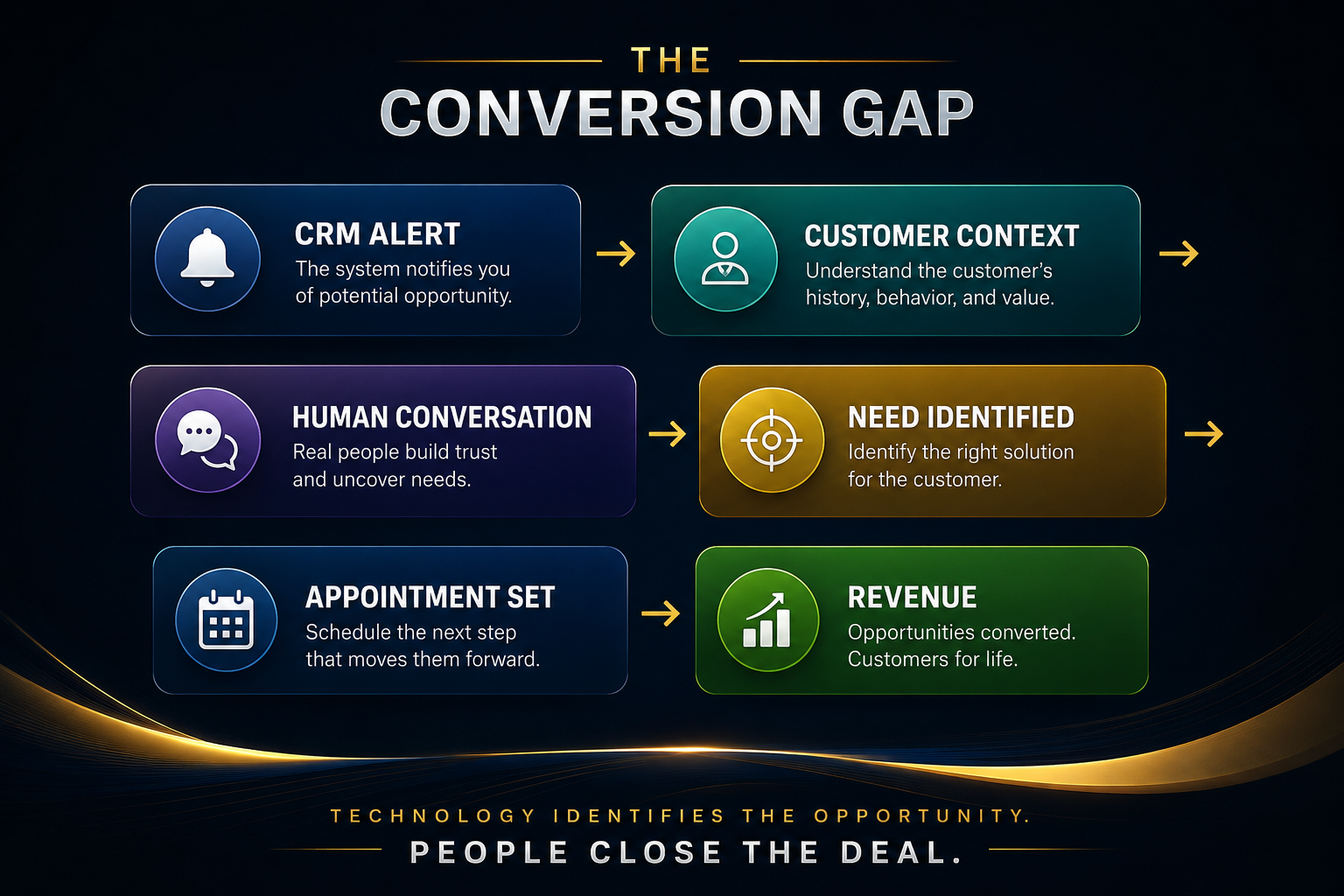
Why a Completed CRM Task Is Not the Same as a Customer Conversation
Here is something most dealer principals and general managers have never had someone say to them directly: a 100% task completion rate does not tell you anything about how much real customer contact your team is actually making.
A closed task in the CRM could mean any of the following. The employee left a voicemail. The employee sent a text that was never returned. The employee sent an email that went to a promotions folder. The employee marked it complete and moved on because the queue was long and the afternoon was slow. The CRM records all four of those outcomes identically. The dashboard looks clean. The revenue never came.
When you look at a task completion report, you learn how many boxes were checked. You do not learn:
- How many actual two-way conversations happened with a real customer on the other end
- How many customer needs were uncovered during those conversations
- How many equity positions were explained to a customer in terms they understood
- How many service customers were walked over to the sales floor or introduced to a consultant
- How many qualified appointments were booked with a time, a name, and context for the desk
- How many vehicles were acquired through trade conversations that started in the service lane
- How much gross resulted from flagged opportunities versus how much was left behind
This distinction matters because managers make decisions based on what they measure. If the metric is task completion, your team optimizes for task completion. If the metric is actual conversations with documented outcomes, you get actual conversations. Most stores are measuring the former and wondering why the latter never shows up in the numbers.
“The CRM marks the task done. It never tells you whether the customer picked up, whether they were interested, or whether the conversation moved anything forward. Those are the numbers that actually matter.”
The Four Things Technology Cannot Do
This is not an argument against your tech stack. If someone is telling you to unplug your CRM, walk away from that conversation. The argument here is narrower and more specific: there are four things that every dealership needs done on a daily basis that no software has ever been able to deliver.
- Read the room. The ninety seconds after a service customer receives a large repair estimate is the highest-converting moment in a franchise dealership. It requires being physically present, watching someone's face, and responding to what they're actually feeling, not what they filled out on a form six months ago. No trigger-based system on the market today can tell the difference between a customer who is mildly annoyed and one who is genuinely reconsidering the vehicle. A trained person standing in the right place at the right moment can see it, name it, and act on it.
- Transfer trust it did not earn. When a service customer has seen the same advisor three times this year, that advisor has built real credibility. An SMS from a short code the customer has never seen before does not inherit that trust. Neither does an email from a CRM domain. Trust moves person to person or it does not move at all. A text from your dealership to a customer who just got a $2,600 estimate reads as exactly what it is: an upsell from the company that just delivered bad news.
- Handle the objection pivot. "I still owe too much." "I'm not looking to start over on payments." "I just want to get this one fixed and see how it goes." Every experienced automotive professional knows those are not rejections. They are the start of a conversation. Automation processes them as a closed loop and moves to the next record. A person who knows what to listen for hears an opening and works from there.
- Own the number. Software cannot sit in a Monday morning manager meeting and account for why forty-two flagged opportunities went untouched last week. Accountability requires a person whose name is attached to the outcome. You can coach a salesperson. You cannot coach a dashboard. The minute a result becomes software's responsibility, it stops being anyone's responsibility.
The Service Drive Is the Highest-Density Opportunity in Your Operation
Work the math against your own DMS numbers. If your store is writing 900 repair orders per month and a conservative 20% of those customers are sitting in a genuinely workable equity or trade-up position, that is 180 real opportunities showing up at your location every single month. Most of them drive out without ever knowing a trade conversation was possible. They leave trusting your brand, willing to come back for service, but completely unaware that a new or certified vehicle was within reach of their current payment.
Service customers are categorically different from cold internet leads. With a service customer, you already know the vehicle's service history and mechanical condition. You already know their payment behavior. You know how long they have owned the vehicle. You have a service relationship that the customer values. That context changes the entire dynamic of the sales conversation. It is not a cold call. It is a continuation of a relationship the customer already chose to be in.
The service customers most likely to be ready for a conversation right now include:
- Owners with vehicles approaching or past 80,000 miles, particularly on models with known reliability inflection points
- Customers who just received a repair estimate over $1,500 on a vehicle they have already spent significantly on in the past year
- Customers whose lease or loan is within 9 to 12 months of maturity and who have not been contacted about their next vehicle
- Long-term customers with meaningful equity who have never been approached about a trade-up conversation
- Repeat service customers who have been coming in for years but have never been connected to the sales floor
The Repair Estimate Conversation Most Advisors Don't Have
When a customer is handed a significant estimate, their mind is already doing the math. They are comparing what they will spend on repairs against what they owe, what the vehicle is worth, and what it would cost them to move into something newer. That mental calculation is happening whether or not anyone in your store facilitates it.
The right conversation is direct and non-pressured: "Given where you are on your current vehicle, it might be worth 20 minutes to see what you could be driving for a similar monthly payment. We have a few things on the lot right now that might make sense." That sentence, delivered by the right person at the right moment, opens more conversations than any automated follow-up sequence ever will. One well-timed offer to have a conversation is worth more than two hundred alerts that land in a notification tray nobody checks.
Automation Metrics
- Emails sent
- Tasks completed
- Alerts generated
- Texts delivered
Business Outcomes
- Real conversations
- Appointments booked
- Trades acquired
- Units sold and gross retained
How AI Makes This Better — Without Replacing the Person
The role of AI in an effective service-to-sales program is to compress the preparation time and improve the targeting precision of the person having the conversation. AI can score equity positions and rank them by conversion likelihood. It can cross-reference vehicle age, mileage, and service history to surface the customers who are most likely to respond positively to a trade conversation. It can identify which certified vehicles on your lot are the strongest matches for specific customers based on payment parameters. It can flag when a warranty is about to expire and prompt outreach before the customer discovers the exposure on their own.
All of that intelligence is genuinely useful. The question is what happens to it. If the AI scores 200 customers this month and those scores sit in a dashboard that nobody acts on, the ROI on the AI is exactly zero. The scores only matter when they land in the hands of a person who knows how to use them to start a real conversation.
Run either tool without the other and you get a predictable, expensive failure. Automation without human execution produces beautiful reporting on revenue that never materialized. Human execution without data produces effort aimed at the wrong customers, burning time and relationship capital on conversations that never had a reasonable chance. The combination works. Neither one alone does.
Why Assigning This to an Existing Role Almost Never Works
Most dealers who recognize the service-to-sales opportunity try to solve it by adding it to someone's existing job description. The service advisor is asked to introduce trade conversations. The sales manager is asked to walk the drive. A BDC rep is given a supplemental list to work between their regular calls.
This almost never produces a sustained result, and the reason is structural. Service advisors are paid on hours and effective labor rate. Introducing a trade conversation takes time away from writing ROs and creates a role conflict the customer can feel. Most advisors will make an attempt or two and stop, and they are entirely rational to do so. Sales consultants shift back to floor traffic the moment the showroom picks up because that is where their pay plan lives. BDC reps working a supplemental list treat it as secondary, because it is secondary.
Within 60 to 90 days, the informal program has eroded. Not because the opportunity isn't there. Because nobody owned it exclusively, and nothing that belongs to everyone belongs to anyone.
A dedicated process, where one person's entire job is working the service-to-sales conversion, solves the accountability problem at the structural level. The list gets worked every day because that is the job. The calls get made. The appointments get set. Management can track actual outcomes because there is an actual person to track them against.
What Service to Sales Actually Looks Like in Practice
Barry Farber's approach to service-to-sales conversion begins before a single call is made. Step one is mining the existing data: cross-referencing service repair orders, CRM records, equity positions, lease and loan maturities, and ownership history to identify which customers are genuinely ready for a conversation and which can wait. That prioritization is where most internally run programs fail. Without it, the team works the list in whatever order it comes out of the system, spending equal effort on the highest-probability and lowest-probability opportunities alike.
Step two is prioritization. A customer with seven months left on a lease, meaningful equity, and three service visits in the past twelve months is a fundamentally different conversation than someone who is current on payments, recently serviced, and not showing any trade signals. Working the right forty customers well produces far better results than working 200 customers the same way.
Step three is the conversation itself. BF Promotions reaches out with a specific, informed reason to talk. The call references the customer's actual vehicle, their actual situation, and their history with the store. The goal is not to pitch. It is to create a booked appointment with a specific time, a specific salesperson, and enough context for your desk to structure the deal before the customer walks through the door.
What your sales team receives is an appointment that already has a story: the customer's vehicle history, their current equity position, the specific reason they agreed to come in, and what they said they were looking for. That information changes how the desk approaches the deal and improves the customer experience from the moment they arrive.
Learn more about our service-to-sales and BDC programs and how they work inside existing dealership operations.
Run This 10-Minute Dealership Follow-Up Audit
If you want to know where the gap is in your operation, you don't need a consultant to tell you. Pull last month's numbers and answer these ten questions honestly:
- How many service repair orders did we write last month?
- How many of those customers were evaluated against our equity database or trade-up criteria?
- Of the customers flagged as potential opportunities, how many received a personal outreach call from a real person?
- Of those calls, how many resulted in actual two-way conversations, not voicemails, not texts, not emails sent?
- How many service-to-sales appointments were booked last month with a documented time and assigned salesperson?
- How many vehicles were acquired through service-drive outreach versus what we bought at auction?
- How many CRM tasks were marked complete last month without a documented customer response?
- How many unsold showroom visitors from the past 90 days received meaningful follow-up beyond an automated email sequence?
- Are our managers tracking how many real conversations happened, or just how many tasks were completed?
- If I pulled last month's flagged equity list right now and counted how many customers had an actual phone conversation with someone at this store, what would that number be?
Most dealers who run this audit find the gap between their task-completion rate and their actual conversation rate is significant. That gap represents real revenue that stayed inside your customer base, unworked, last month. The good news is that it did not leave. It is still there this month, waiting for someone to go get it.
Your Next Deal May Already Be in Your Service Lane
If your dealership is generating service traffic, running CRM alerts, and marking tasks complete but not seeing the appointments and acquisitions those numbers should produce, BF Promotions can help identify exactly where the process is breaking down.
Schedule a Free Consultation →Or call Barry directly: 914-447-7405